Developer Guide
UML Diagram
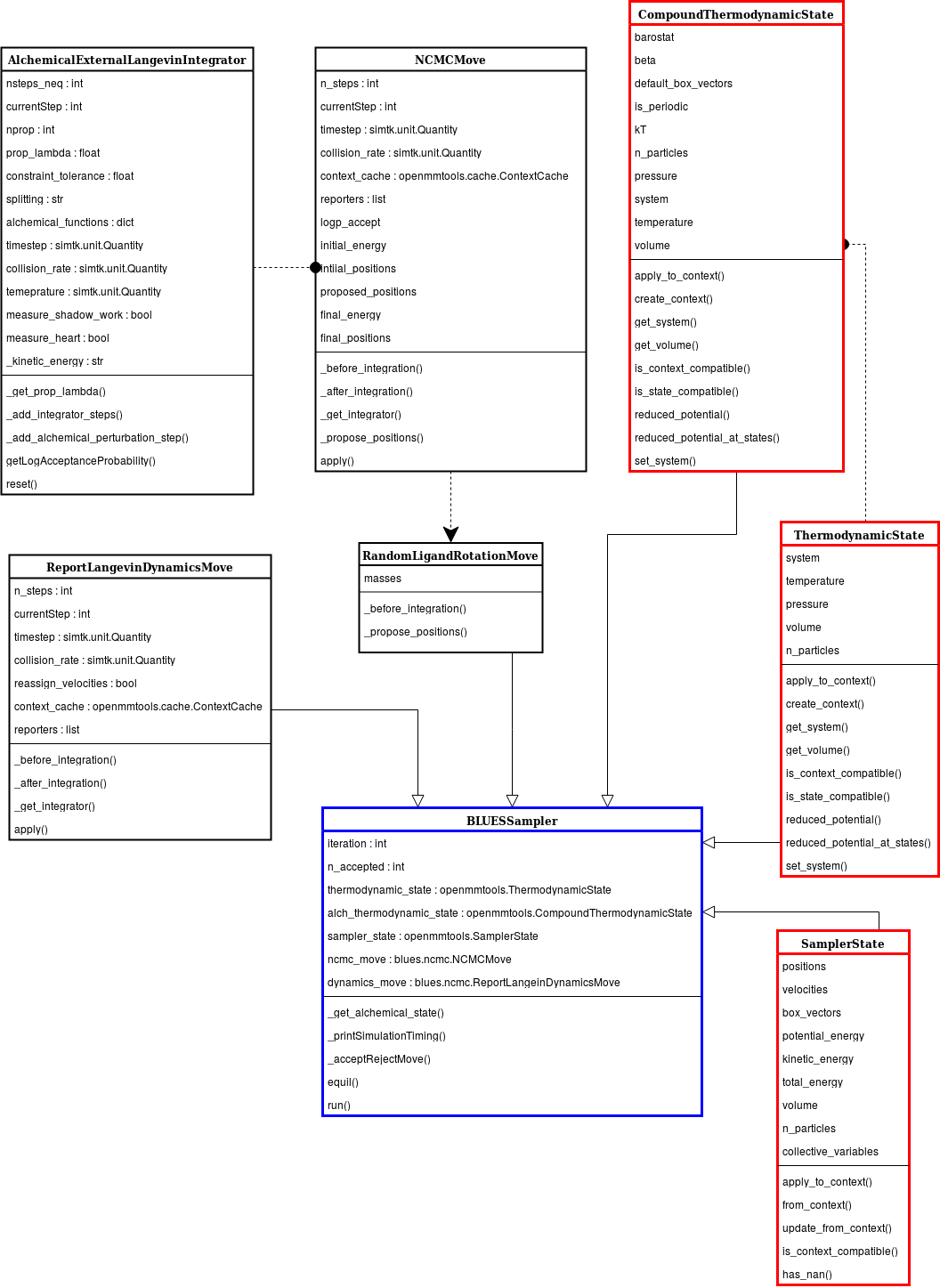
OpenMMTools Objects
Highlighted in red are 3 objects that we use from the openmmtools library. They are the ThermodynamicState, CompoundThermodynamicState, and SamplerState objects. For more details of each class, please see the official openmmtools documentation.
Briefly, the ThermodynamicState class represents the portion of the state of an openmm.Context that does not change with integration (i.e. particles, temperature, or pressure). The CompoundThermodynamicState class is essentially the same as the ThermodynamicState class except in this package, it is used for the handling the openmmtools.alchemy.AlchemicalState object. Thus, in order to create the CompoundThermodynamicState, one needs to first create the plain ThermodynamicState object first. If a CompoundThermodynamicState object is not provided to the blues.ncmc.BLUESSampler class, one is created using the default parameters from the given ThermodynamicState. Lastly, the SamplerState class represents the state of an openmm.Context which does change with integration (i.e positions, velocities, and box_vectors). Within the context of this package, the SamplerState is used to sync information between the MD and NCMC simulations.
Integrators and Moves
Integrators
Integrators are the lowest level openmm objects this package interacts with, where each intergrator is tied to an openmm.Context that it advances. Each integrator is generated by using the embedded function _get_integrator() function within each move class. The integrators will control whether we are carrying out the Non-equilibirum Candidate Monte Carlo (NCMC) or Molecular Dynamics (MD) simulation.
Every move class has 3 hidden methods: _get_integrator() for generating the integrator of each move class, _before_integration() for performing any necessary setup before integration, and _after_integration() for performing any cleanup or data collection after integration. Every move class also contains the apply() method which carries out calls to the 3 hidden methods and stepping with the integrator.
In this package, we provide the move class blues.ncmc.ReportLangevinDynamicsMove to execute the MD simulation. As the name suggests, this will carry forward the MD simulation using Langevin dynamics, by generating an openmm.LangevinIntegrator. This class is essentially the same as the openmmtools.LangevinDynamicsMove but with modifications to the apply() method which allows storing simulation data for the MD simulation.
For running the NCMC simulation, we provide a custom integrator
blues.integrator.AlchemicalExternalLangevinIntegrator. This integrator is generated in every move which inherits from the base class blues.ncmc.NCMCMove. Every class which inherits from the base move class must override the _propose_positions() method. If necessary, one can override the _before_integration() and _after_integration() methods for any necessary setup and cleanup. Again, these hidden methods will be called when a call is made to the apply() method from the move class.
Moves
In order to implement custom NCMC moves, inherit from the base class and override the _propose_positions() method. This method is expected to take in a positions array of the atoms to be modified and returns the proposed positions. In pseudo-code, it would look something like:
from blues.ncmc import NCMCMove
class CustomNCMCMove(NCMCMove):
    def _propose_positions(positions):
        """Add 1 nanometer displacement vector."""
        positions_unit = positions.unit
        unitless_displacement = 1.0 / positions_unit
        displacement_vector = unit.Quantity(np.random.randn(3) * unitless_displacement_sigma, positions_unit)
        proposed_positions = positions + displacement_vector
        return proposed_positions
In this package, we provide the blues.ncmc.RandomLigandRotationMove in order to propose a random ligand rotation about the center of mass. This class overrides the _before_integration() method for obtaining the masses of the ligand and overrides the _propose_positions() function for generating the rotated coordinates. Updating the context with the rotated coordinates is handled when the apply() method is called in the move class. Code snippet of the class is shown below:
from blues.ncmc import RandomLigandRotationMove
class RandomLigandRotationMove(NCMCMove):
   def _before_integration(self, context, thermodynamic_state):
      """Obtain the masses of the ligand before integration."""
      super(RandomLigandRotationMove, self)._before_integration(context, thermodynamic_state)
      masses, totalmass = utils.getMasses(self.atom_subset, thermodynamic_state.topology)
      self.masses = masses
   def _propose_positions(self, positions):
       # Calculate the center of mass
       center_of_mass = utils.getCenterOfMass(positions, self.masses)
       reduced_pos = positions - center_of_mass
       # Define random rotational move on the ligand
       rand_quat = mdtraj.utils.uniform_quaternion(size=None)
       rand_rotation_matrix = mdtraj.utils.rotation_matrix_from_quaternion(rand_quat)
       # multiply lig coordinates by rot matrix and add back COM translation from origin
       proposed_positions = numpy.dot(reduced_pos, rand_rotation_matrix) * positions.unit + center_of_mass

       return proposed_positions
Since BLUES (v0.2.5) the API has been re-written to be more compatible with the openmmtools API. This means one can turn a regular Markov Chain Monte Carlo (MCMC) move from the openmmtools library into an NCMC move to be used in this package. In this case, one simply needs to make use of dual inheritance, using the blues.ncmc.NCMCMove that we provide and override the _get_integrator() method to generate the NCMC integrator we provide, i.e. blues.integrator.AlchemicalExternalLangevinIntegrator. When using dual inheritance, it is important that you first inherit the desired MCMC move and then the blues.ncmc.NCMCMove class. For example, if we wanted to take the openmmtools.mcmc.MCDisplacementMove class and turn it into an NCMC move, it would look like:
from blues.ncmc import NCMCMove
from openmmtools.mcmc import MCDisplacementMove
class NCMCDisplacementMove(MCDisplacementMove, NCMCMove):
    def _get_integrator(self, thermodynamic_state):
        return NCMCMove._get_integrator(self,thermodynamic_state)
BLUESSampler
The blues.ncmc.BLUESSampler object ties together all the previously mentioned state objects and the two move classes for running the NCMC+MD simulation. Details of the parameters for this class are listed in the Modules documentation. For a more detailed example of it’s usage see the Usage documentation.
To be explicit, the input parameters refer to the objects below:
thermodynamic_state :
openmmtools.states.ThermodynamicStatealch_thermodynamic_state :
openmmtools.states.CompoundThermodynamicStatesampler_state :
openmmtools.states.SamplerStatedynamics_move :
blues.ncmc.ReportLangevinDynamicsMovencmc_move :
blues.ncmc.RandomLigandRotationMovetopology :
openmm.Topology
When the run() method in the blues.ncmc.BLUESSampler is called the following takes place:
- Initialization:
_print_host_info(): Information print out of host_printSimulationTiming(): Calculation of total number of stepsequil(): Equilibration
- BLUES iterations:
ncmc_move.apply(): NCMC simulation_acceptRejectMove(): Metropolizationdynamics_move.apply(): MD Simulation
A code snippet of the run() method is shown below:
def run(self, n_iterations=1):
    context, integrator = cache.global_context_cache.get_context(self.thermodynamic_state)
    utils.print_host_info(context)
    self._printSimulationTiming(n_iterations)
    if self.iteration == 0:
        self.equil(1)

    self.iteration = 0
    for iteration in range(n_iterations):
        self.ncmc_move.apply(self.alch_thermodynamic_state, self.sampler_state)

        self._acceptRejectMove()

        self.dynamics_move.apply(self.thermodynamic_state, self.sampler_state)

        self.iteration += 1
Initialization
The first thing that occurs when run() is called is the initialization stage. During this stage, a call is made to utils.print_host_info() and the _printSimulationTiming() method which will print out some information about the host machine and the total number of force evaluations and simulation time. The output will look something like below:
In the blues.ncmc.BLUESSampler class, there is an equil() method which lets you run iterations of just the MD simulation in order to equilibrate your system before running the NCMC+MD hybrid simulation. An equilibration iteration, in this case is controlled by the given attribute n_steps from the dynamics_move class. For example, if I create a blues.ncmc.ReportLangevinDynamicsMove class with n_steps=20 and call the blues.ncmc.BLUESSampler.equil(n_iterations=100), this will run (n_steps x n_iterations) or 2000 steps of MD or 2 picoseconds of MD simulation time. When the run() method is called without a prior call to the equil() method, the class will always run 1 iteration of equilibration in order to set the initial conditions in the MD simulation. This is required prior to running the NCMC simulation.
BLUES Iterations
NCMC Simulation
After at least 1 iteration of equilibration, the blues.ncmc.BLUESSampler class will then proceed forward with running iterations of the NCMC+MD hybrid simulation. It will first run the NCMC simulation by calling the apply() method on the ncmc_move class or, for sake of this example, the blues.ncmc.RandomLigandRotationMove class. The apply() method for the ncmc_move will take in the alch_thermodynamic_state parameter or specifically the openmmtools.states.CompoundThermodynamicState object.
A code snippet of the ncmc_move.apply() method is shown below:
def apply(self, thermodynamic_state, sampler_state):
    if self.context_cache is None:
        context_cache = cache.global_context_cache
    else:
        context_cache = self.context_cache
    integrator = self._get_integrator(thermodynamic_state)
    context, integrator = context_cache.get_context(thermodynamic_state, integrator)
    sampler_state.apply_to_context(context, ignore_velocities=False)
    self._before_integration(context, thermodynamic_state)
    try:
        endStep = self.currentStep + self.n_steps
        while self.currentStep < endStep:
            alch_lambda = integrator.getGlobalVariableByName('lambda')
            if alch_lambda == 0.5:
                sampler_state.update_from_context(context)
                proposed_positions = self._propose_positions(sampler_state.positions[self.atom_subset])
                sampler_state.positions[self.atom_subset] = proposed_positions
                sampler_state.apply_to_context(context, ignore_velocities=True)

            nextSteps = endStep - self.currentStep
            stepsToGo = nextSteps
            while stepsToGo > 10:
                integrator.step(10)
                stepsToGo -= 10
            integrator.step(stepsToGo)
            self.currentStep += nextSteps
    except Exception as e:
        print(e)
    else:
        context_state = context.getState(
            getPositions=True,
            getVelocities=True,
            getEnergy=True,
            enforcePeriodicBox=thermodynamic_state.is_periodic)

        self._after_integration(context, thermodynamic_state)
        sampler_state.update_from_context(
            context_state, ignore_positions=False, ignore_velocities=False, ignore_collective_variables=True)
        sampler_state.update_from_context(
            context, ignore_positions=True, ignore_velocities=True, ignore_collective_variables=False)
When the apply() method on ncmc_move is called, it will first generate the blues.integrators.AlchemicalExternalLangevinIntegrator by calling the _get_integrator() method inherent to the move class. Then, it will create (or fetch from the context_cache) a corresponding openmm.Context given the alch_thermodynamic_state. Next, the sampler_state which contains the last state of the MD simulation is synced to the newly created context from the corresponding alch_thermodynamic_state. Particularly, the context will be updated with the box_vectors, positions, and velocities from the last state of the MD simulation.
Just prior to integration, a call is made to the _before_integration() method in order to store the initial energies, positions, box_vectors and the masses of the ligand to be rotated. Then, we actually step with the integrator where we perform the ligand rotation when lambda has reached the half-way point or lambda=0.5, continuing integration until we have completed the n_steps. After the integration steps have been completed, a call is made to the _after_integration() method to store the final energies, positions, and box_vectors. Lastly, the sampler_state is updated from the final state of the context.
Metropolization
After advancing the NCMC simulation, a call is made to the _acceptRejectMove() method embedded in the blues.ncmc.BLUESSampler class for metropolization of the proposed move.
A code snippet of the _acceptRejectMove() is shown below:
def _acceptRejectMove(self):
    integrator = self.dynamics_move._get_integrator(self.thermodynamic_state)
    context, integrator = cache.global_context_cache.get_context(self.thermodynamic_state, integrator)
    self.sampler_state.apply_to_context(context, ignore_velocities=True)
    alch_energy = self.thermodynamic_state.reduced_potential(context)

    correction_factor = (self.ncmc_move.initial_energy - self.dynamics_move.final_energy + alch_energy - self.ncmc_move.final_energy)
    logp_accept = self.ncmc_move.logp_accept
    randnum = numpy.log(numpy.random.random())

    logp_accept = logp_accept + correction_factor
    if (not numpy.isnan(logp_accept) and logp_accept > randnum):
        self.n_accepted += 1
    else:
        self.accept = False
        self.sampler_state.positions = self.ncmc_move.initial_positions
        self.sampler_state.box_vectors = self.ncmc_move.initial_box_vectors
Here, is we compute a correction term for switching between the MD and NCMC integrators and factor this in with natural log of the acceptance probability (logp_accept). Then, a random number is generated in which: the move is accepted if the random number is less than the logp_accept or rejected if greater. When the move is rejected, we set the positions and box_vectors on the sampler_state to the initial positions and box_vectors from the NCMC simulation. If the move is accepted, nothing on the sampler_state is changed so that the following MD simulation will contain the final state of the NCMC simulation.
MD Simulation
After metropolization of the previously proposed move, a call is made to the apply() method on the given dynamics_move object. In this example, this would refer to the blues.ncmc.ReportLangevinDynamicsMove class to run the MD simulation.
A code snippet of the dynamics_move.apply() method is shown below:
def apply(self, thermodynamic_state, sampler_state):
    if self.context_cache is None:
        context_cache = cache.global_context_cache
    else:
        context_cache = self.context_cache

    integrator = self._get_integrator(thermodynamic_state)
    context, integrator = context_cache.get_context(thermodynamic_state, integrator)
    thermodynamic_state.apply_to_context(context)

    sampler_state.apply_to_context(context, ignore_velocities=self.reassign_velocities)
    if self.reassign_velocities:
        context.setVelocitiesToTemperature(thermodynamic_state.temperature)

    self._before_integration(context, thermodynamic_state)
    try:
        endStep = self.currentStep + self.n_steps
        while self.currentStep < endStep:
            nextSteps = endStep - self.currentStep
            stepsToGo = nextSteps
            while stepsToGo > 10:
                integrator.step(10)
                stepsToGo -= 10
            integrator.step(stepsToGo)
            self.currentStep += nextSteps

    except Exception as e:
        print(e)

    else:
        context_state = context.getState(
            getPositions=True,
            getVelocities=True,
            getEnergy=True,
            enforcePeriodicBox=thermodynamic_state.is_periodic)
        self._after_integration(context, thermodynamic_state)
        sampler_state.update_from_context(
            context_state, ignore_positions=False, ignore_velocities=False, ignore_collective_variables=True)
        sampler_state.update_from_context(
            context, ignore_positions=True, ignore_velocities=True, ignore_collective_variables=False)
When the apply() method is called, a very similar procedure to the NCMC simulation occurs. The first thing that happens is to generate the integrator through a call to _get_integrator(), where in this given class, it will generate an openmm.LangevinIntegrator given the thermodynamic_state parameter. Then, it will create (or fetch from the context_cache) a corresponding openmm.Context given the thermodynamic_state. Next, the sampler_state, which contains the last state of the NCMC simulation if the previous move was accepted or the initial state of the NCMC simulation if the move was rejected, is used to update box_vectors and positions in the newly created openmm.Context. In this case, we reassign the velocities in the MD simulation in order to preserve detailed balance.
Following, a call is made to _before_integration() to store the intial positions, box_vectors and energies and then we carry forward with the integration for n_steps. After the integration steps have been completed, a call is made to the _after_integration() method to store the final energies and positions. Lastly, the sampler_state object is updated from the final state of the MD simulation context.
This completes 1 iteration of the BLUES cycle. Here, the sampler_state is then used to sync the final state of the MD simulation (i.e. box_vectors, positions, and velocities) from the previous iteration to the NCMC simulation of the next iteration. Then, we repeat the cycle of NCMC -> Metropolization -> MD for the given number of iterations.